The Evidence Chain Map
A control that ran but left no trail didn't run, as far as an auditor is concerned.
@18xBan · GRC Series · Chapter 07
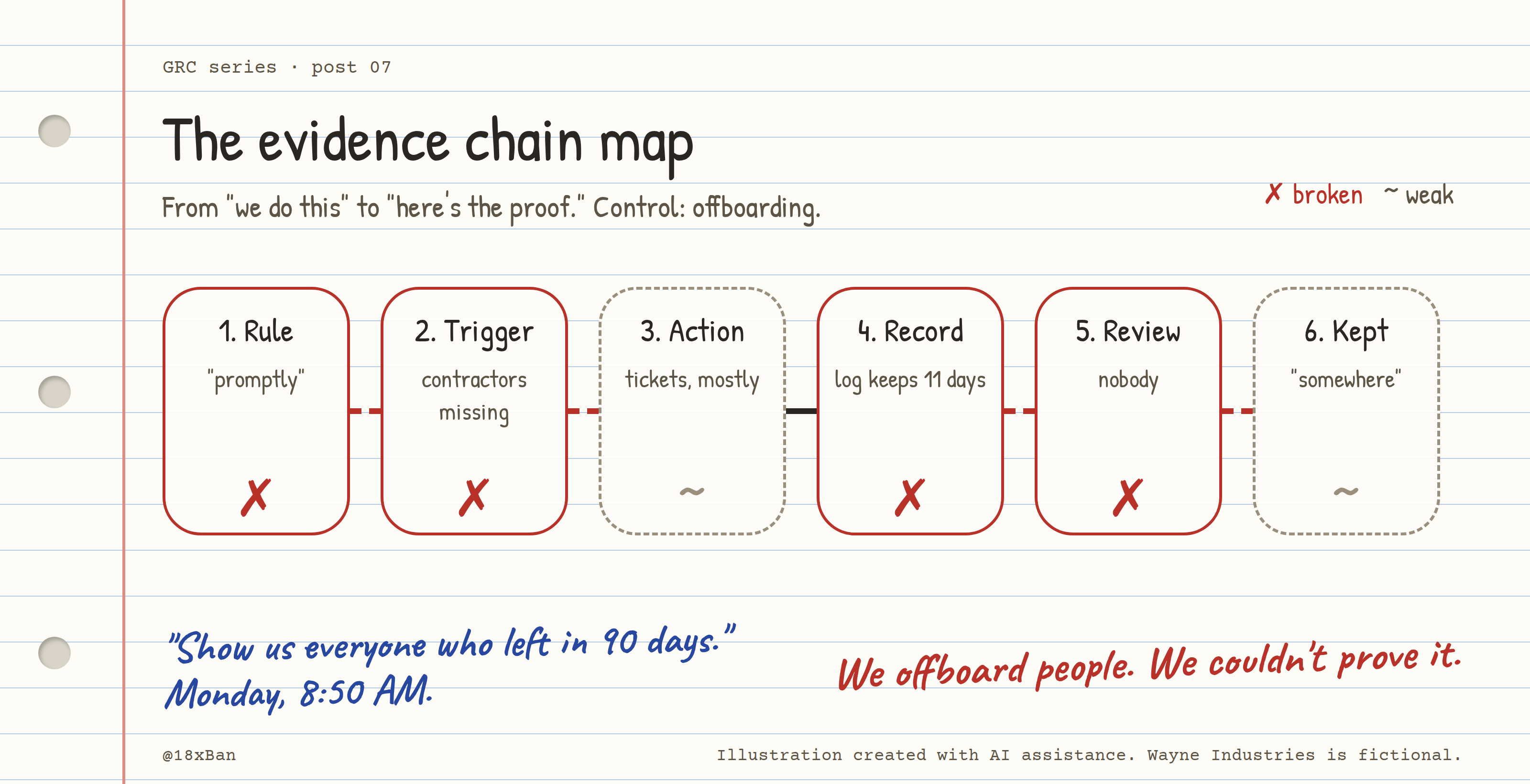
6 links from "we do this" to "here's the proof." 4 were broken, and the other 2 were weak.
Monday, 8:50 AM: "Show us, don't tell us"
The email from Gotham Mutual's vendor-risk team is short and polite.
Ahead of Thursday's walkthrough, please be ready to show that access was removed for everyone who left Wayne in the last 90 days, employees and contractors. We'd like the list of leavers, the date each person left, and the date their access was disabled.
You read it twice and relax a little. Offboarding has an owner now. Farah owns the trigger, and you do the removal. Everyone said "I accept." It's on the list.
Then you try to answer the actual question, and the morning goes sideways.
Farah exports 6 employee departures from the HR system in about 2 minutes. Good start.
"And the contractors?" you ask.
"Contractors aren't in HR," she says. "Finance pays them. Ask accounts payable."
You pull up the domain controller's Security log to grab the "account disabled" events. The oldest event in the log is eleven days old.
By 10 AM you know three things. Wayne does offboard people. Wayne can't prove it. And you're not yet sure it offboards all of them.
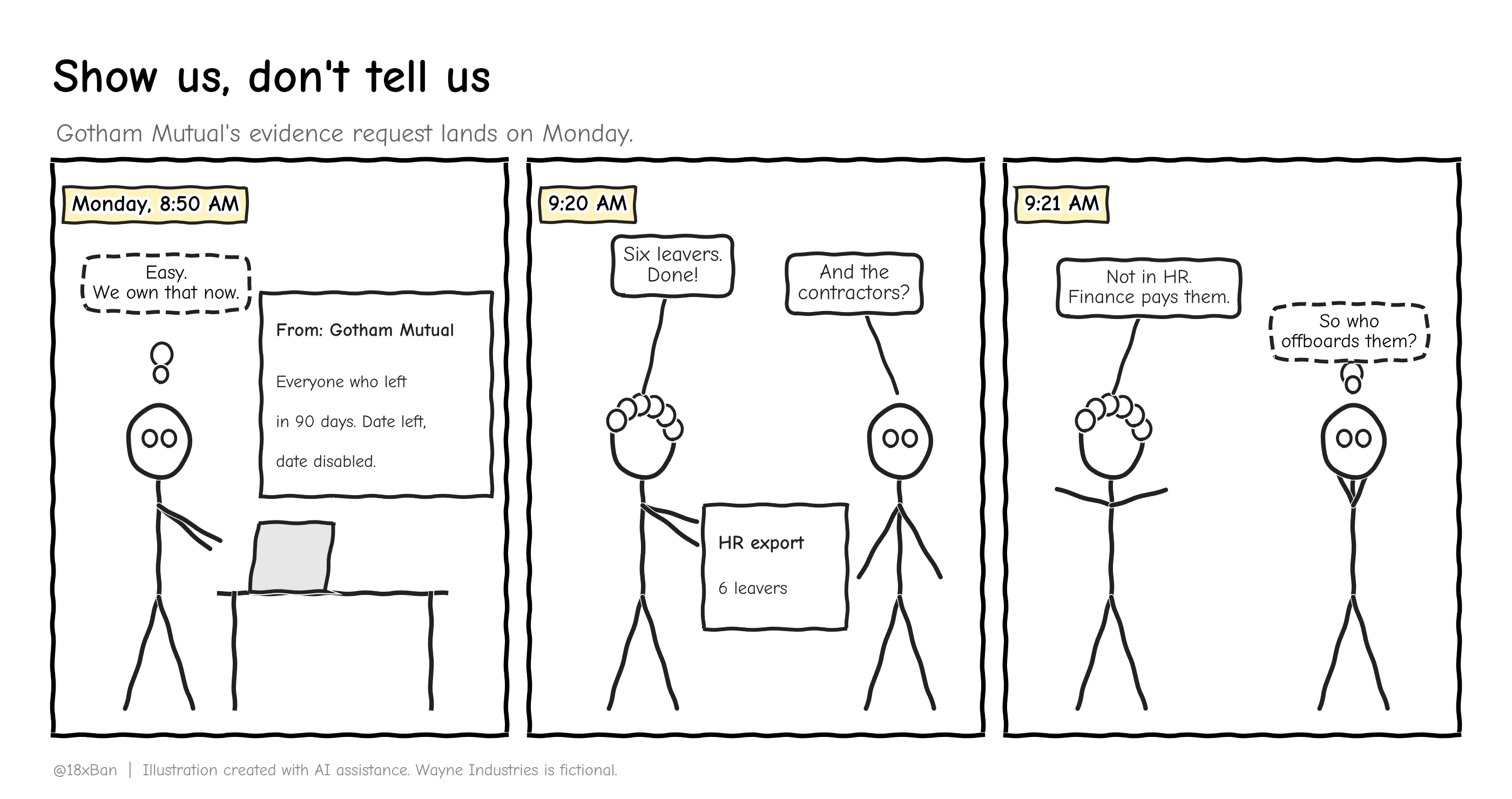
"Show us" is a much harder question than "Do you?"
What an evidence chain actually is
An auditor never takes your word for anything. They follow a chain.
Think of a parcel with tracking. "We shipped it" means nothing. The tracking page shows it was picked up, scanned at the depot, loaded on the truck and signed for at the door. If any scan is missing, you can't prove it arrived, even if it did.
Controls work the same way. For any control, the chain has 6 links:
Rule. Where is it written what should happen, and by when?
Trigger. What starts the control, and is there a complete list of those starts?
Action. Who does the work, and where is the request recorded?
Record. What system writes down that it happened, with a timestamp?
Review. Who checks that it happened correctly, and where is that check recorded?
Kept. Where does the proof live, and will it still be there when an auditor asks?
An evidence chain map is a document that lays out those 6 links for one control. It names the system, the person and the storage location for each link.
The auditor's job is to walk the chain from end to end. Yours is to walk it first.
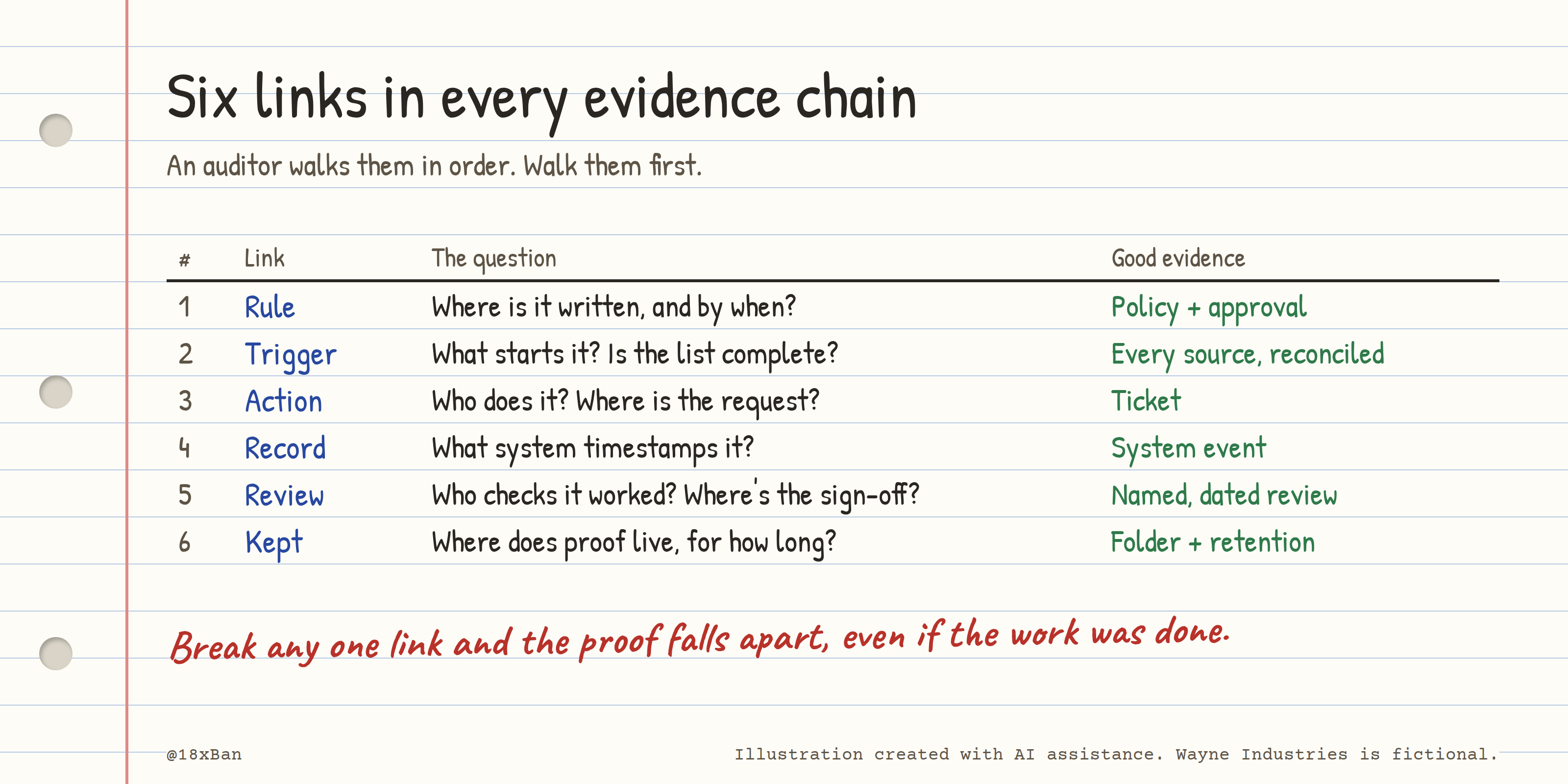
Rule, trigger, action, record, review, kept. Break one and the chain doesn't hold.
The unpopular truth: a control that ran but left no record didn't run, as far as an auditor is concerned. "We always do that" is a statement, not evidence.
How an auditor walks the chain
Auditors have three ways to test a control. NIST SP 800-53A, the US government's guide to assessing controls, names them plainly:
Examine: read documents and records. Policies, tickets, logs.
Interview: talk to the people who run the control.
Test: make the control do its thing and compare what happens with what should happen.
SOC 2 auditors work the same way, even if they use different words. So do ISO 27001 certification auditors.
For offboarding, the walk looks like this:
Ask for the population: every person who left in the period.
Check that the population is complete. Does it match other sources?
Pick a sample, or take all of them if the list is short.
For each person, compare the date they left with the date access was disabled.
Ask who reviews this, and see the record of that review.
Wayne's population was the first thing to break.
Walking Wayne's chain, link by link
Link 1, Rule: "promptly"
Wayne's access control policy is one of the 40 on the shared drive. It says access is removed "promptly" when someone leaves.
"Promptly" can't be tested. An auditor can't count days against it.
CIS Controls v8.1 Safeguard 6.2 asks for accounts to be disabled immediately upon termination. You propose a rule you can measure: access is disabled by the end of the person's last working day. Farah agrees. Dan approves it on Monday afternoon, by email.
That email is the rule, dated and approved.
Link 2, Trigger: half the population is missing
Farah's HR export has six employee departures in the 90-day window.
Accounts payable keeps its own spreadsheet of contractors. 3 contracts ended in the same window. None of them are in the HR system, so none of them ever triggered offboarding.
That's the most common break in any evidence chain. Population completeness means proving your list includes everyone it should. If the list is incomplete, a perfect test of that list proves nothing.
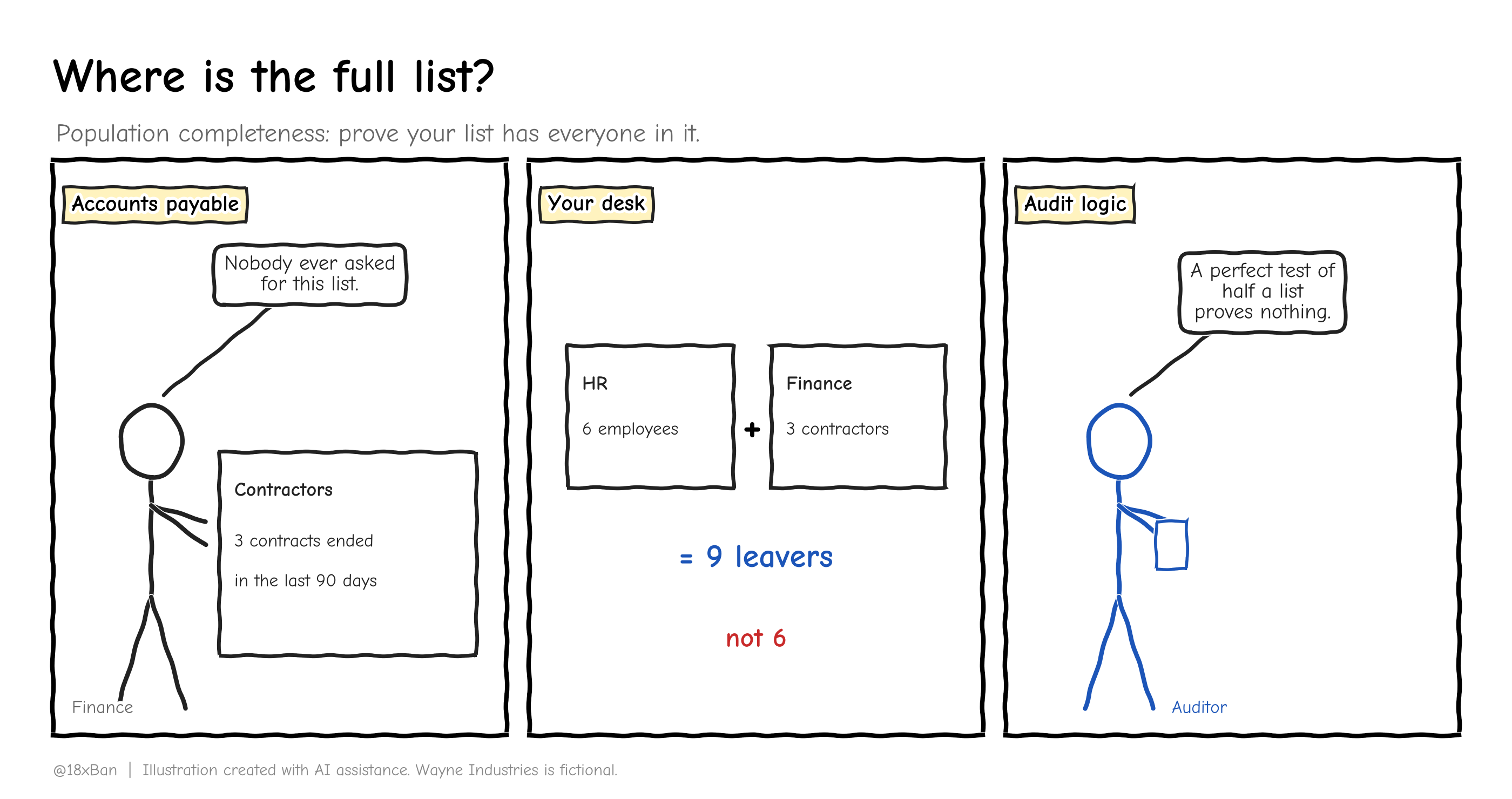
6 leavers in HR. 3 more in a finance spreadsheet nobody connected.
Link 3, Action: tickets, mostly
Offboarding requests go through Deskline, Wayne's support desk. 5 out of 6 employee departures have a ticket. One contractor account was disabled because Priya asked in a hallway. No ticket.
The account was still disabled on time. It just left no trail.
Link 4, Record: eleven days of memory
This is where you find the break that stings most. Windows writes Event ID 4725, "A user account was disabled," to the domain controller's Security log. That's your timestamped record.
Get-WinEvent -ListLog Security -ComputerName DC01 |
  Select-Object LogName, LogMode, MaximumSizeInBytes, RecordCount

Get-WinEvent -ComputerName DC01 -LogName Security -MaxEvents 1 -Oldest |
  Select-Object TimeCreated
LogName  LogMode  MaximumSizeInBytes RecordCount
-------  -------  ------------------ -----------
Security Circular           20971520       48213

TimeCreated
-----------
2024-10-24 06:12:41
Sample output (illustrative). Wayne Industries is fictional.
The log is 20 MB and set to circular, which means new events overwrite the oldest ones. On a busy domain controller, that's about eleven days. Nobody changed it, and nothing ships the events anywhere else.
CIS Safeguard 8.10 asks for audit logs to be kept for at least 90 days. Wayne keeps eleven.
For older disables, there's a second source. Active Directory records when each attribute last changed. Disabling an account changes userAccountControl:
Get-ADReplicationAttributeMetadata -Server DC01 `
  -Object "CN=Rashid Osei,OU=Staff,DC=wayne,DC=example" `
  -Properties userAccountControl |
  Select-Object AttributeName, LastOriginatingChangeTime, Version
AttributeName      LastOriginatingChangeTime Version
-------------      ------------------------- -------
userAccountControl 2024-09-19 14:07:22             3
Sample output (illustrative). Wayne Industries is fictional.
That's useful, but it only shows the last change to that attribute. If someone re-enables and disables the account later, the earlier date is gone. Treat it as supporting evidence, and pair it with the ticket.
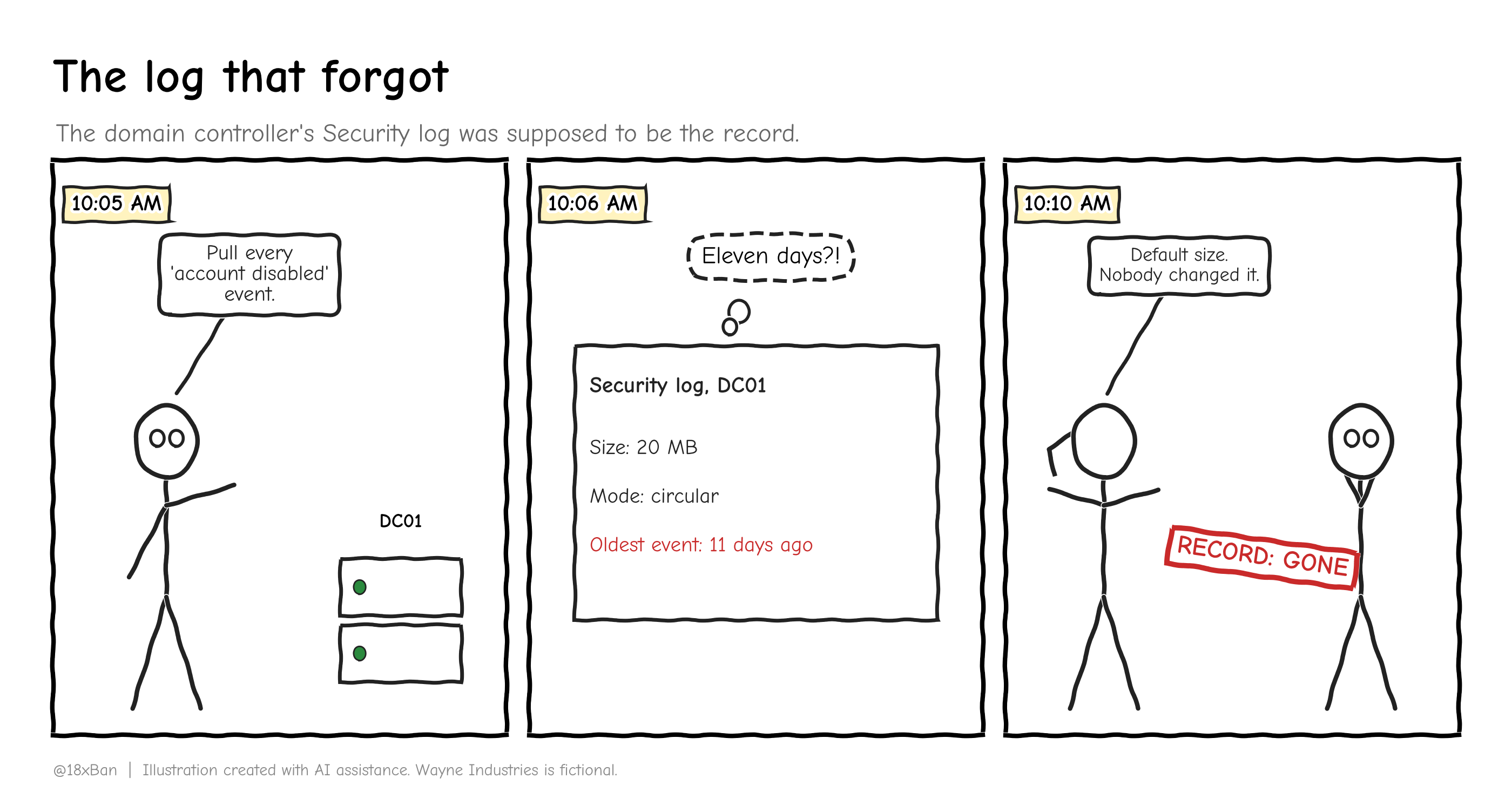
The log that was supposed to be the record forgot everything older than 11 days.
Link 5, Review: nobody
Nobody ever compared "date left" with "date disabled." Not monthly, not ever. So nobody knew whether the control worked.
Link 6, Kept: "somewhere"
The tickets are in Deskline. The log was on DC01 until it wasn't. The HR export lived in Farah's downloads folder.
None of it was in one place, and none of it had a retention period.
The template: SCF Evidence Request List
You don't need to invent a format for this. The Secure Controls Framework (SCF) publishes a free Evidence Request List (ERL). It's a catalogue of the artifacts an assessor would reasonably expect for each control, mapped to SCF controls. The SCF says it can serve as a guidebook for other audits too, not just SCF assessments.
Get it from the SCF website, as part of the free SCF download. https://securecontrolsframework.com/
The ERL tells you what to hand over. It doesn't tell you where it comes from or whether it will still exist. So Wayne keeps the ERL's own columns and adds 6 chain columns to its copy.
Field by field
| Field | Source | What goes in it |
|---|---|---|
| ERL # | SCF | The SCF's identifier for the evidence item |
| Area of Focus | SCF | The domain the artifact belongs to, e.g. identity and access |
| Documentation Artifact | SCF | The name of the thing an assessor asks for |
| Artifact Description | SCF | What the artifact should show |
| SCF Control Mappings | SCF | The SCF controls this artifact supports |
| Control owner | Wayne | The accountable person, from the ownership list |
| Rule | Wayne | Where the requirement is written, and the measurable standard |
| Trigger and population | Wayne | Every source that starts the control, and how you prove the list is complete |
| Action record | Wayne | Where each request and action is logged |
| System record | Wayne | The timestamped system event, and how long it's kept |
| Review | Wayne | Who checks the results, how often, and where the sign-off lives |
| Kept in, for | Wayne | Storage location and retention period |
Wayne before
| Chain column | Offboarding, Monday morning |
|---|---|
| Control owner | Farah (trigger), You (removal) |
| Rule | Access policy (2021): "promptly" |
| Trigger and population | HR system only. Contractors missing |
| Action record | Deskline, when someone remembers |
| System record | Event 4725 on DC01, about 11 days, circular |
| Review | None |
| Kept in, for | Scattered. No retention set |
Wayne after
| Chain column | Offboarding, Wednesday evening |
|---|---|
| Control owner | Farah (trigger), You (removal), Dan (review) |
| Rule | Disabled by end of last working day. Approved by Dan, Monday |
| Trigger and population | HR export plus the accounts payable contractor list, reconciled monthly against the AD Contractors OU |
| Action record | Deskline ticket required for every disable, including contractors |
| System record | Event 4725 forwarded to CloudWatch Logs, 400-day retention. DC01 log raised to 1 GB |
| Review | Monthly leaver test by you, signed by Farah, reviewed by Dan |
| Kept in, for | Evidence/Access/Offboarding/ on the shared drive, kept 3 years |
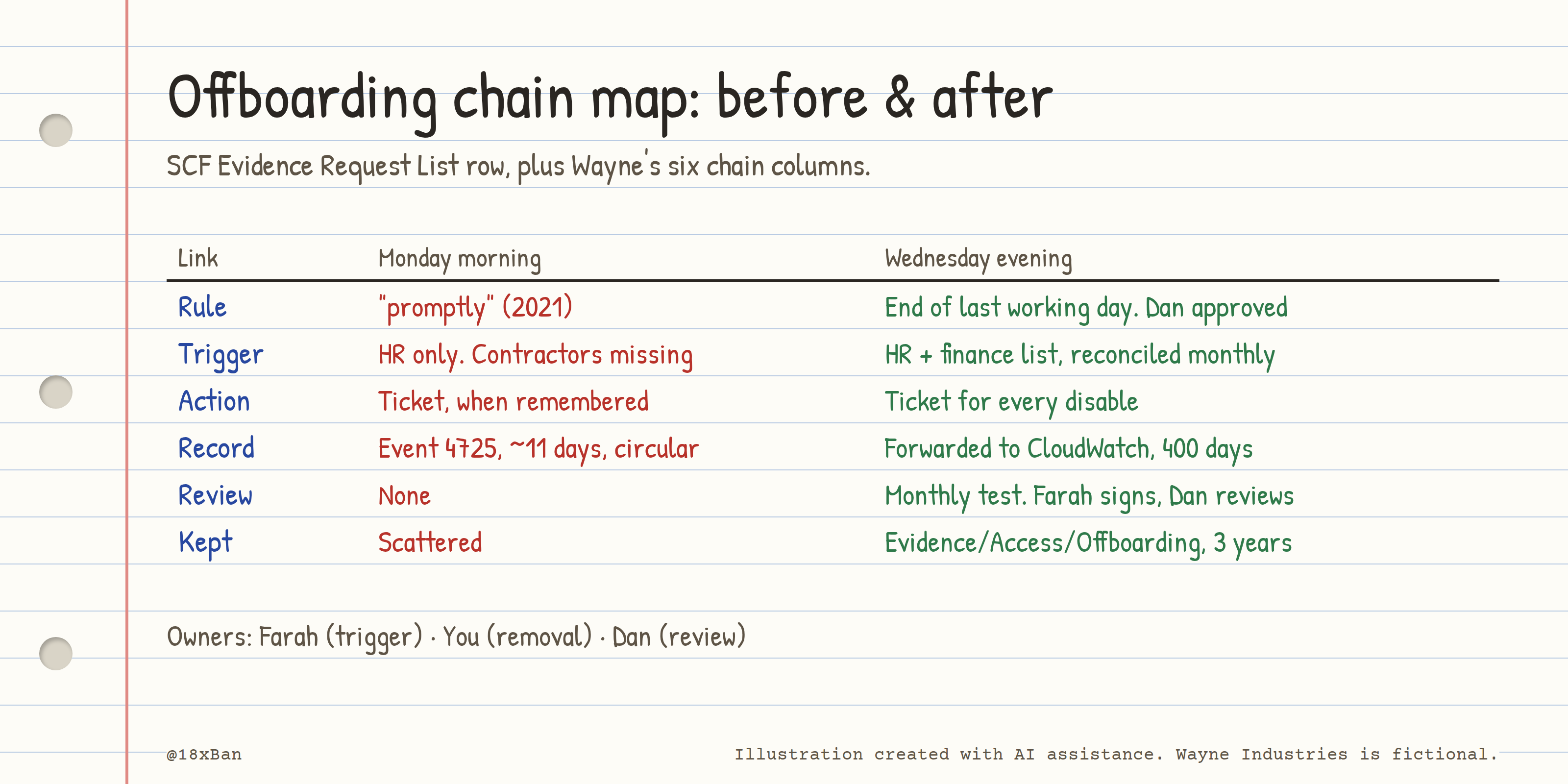
Same control, same owners. Now every link says where the proof lives.
The unpopular truth: most evidence is collected the week before an audit, from whatever still exists. That's why so much of it gets rejected. Evidence has to be designed into the control, not gathered after it.
The test: 9 people, 2 problems
With both lists joined, you test all nine leavers. 9 is small enough to skip sampling.
Contractor accounts first, since that's where you're least sure:
Get-ADUser -Filter 'Enabled -eq $true' `
  -SearchBase "OU=Contractors,DC=wayne,DC=example" `
  -Properties LastLogonDate, AccountExpirationDate |
  Select-Object SamAccountName, Enabled, LastLogonDate, AccountExpirationDate
SamAccountName Enabled LastLogonDate        AccountExpirationDate
-------------- ------- -------------        ---------------------
ctr.jlee          True 2024-09-24 16:48:03
ctr.mvarga        True 2024-10-18 15:21:37
ctr.dfarouk       True 2024-11-01 09:02:15
Sample output (illustrative). Wayne Industries is fictional.
ctr.dfarouk is a current contractor, which is fine. The other 2 contracts ended 41 days and 17 days ago. Both accounts still work, and Wayne's VPN signs people in with their AD account.
Neither account shows a sign-in after the contract ended. LastLogonDate can lag by up to 2 weeks, though, so you check the VPN logs too. Nothing there either.
You disable both accounts on the spot, with tickets. Then you set an expiry date on every contractor account, so the account shuts itself off even if nobody remembers.
The full result:
| # | Account | Type | Last day | Disabled | Evidence | Result |
|---|---|---|---|---|---|---|
| 1 | a.brooks | Employee | Aug 16 | Aug 16 | Ticket + AD metadata | Pass |
| 2 | m.chen | Employee | Aug 30 | Aug 30 | Ticket + AD metadata | Pass |
| 3 | r.osei | Employee | Sep 13 | Sep 19 | Ticket + AD metadata | Late, 4 business days |
| 4 | t.walsh | Employee | Sep 27 | Sep 27 | Ticket + AD metadata | Pass |
| 5 | k.dubois | Employee | Oct 11 | Oct 11 | Ticket + AD metadata | Pass |
| 6 | s.patel | Employee | Oct 25 | Oct 25 | Ticket + Event 4725 | Pass |
| 7 | ctr.hsato | Contractor | Aug 23 | Aug 23 | AD metadata only, no ticket | Pass, weak evidence |
| 8 | ctr.jlee | Contractor | Sep 24 | Nov 4 | Ticket (today) | Exception, 41 days |
| 9 | ctr.mvarga | Contractor | Oct 18 | Nov 4 | Ticket (today) | Exception, 17 days |
Row 3 happened because the ticket was raised 4 days after the person left. Rows 8 and 9 happened because contractors never triggered anything at all.
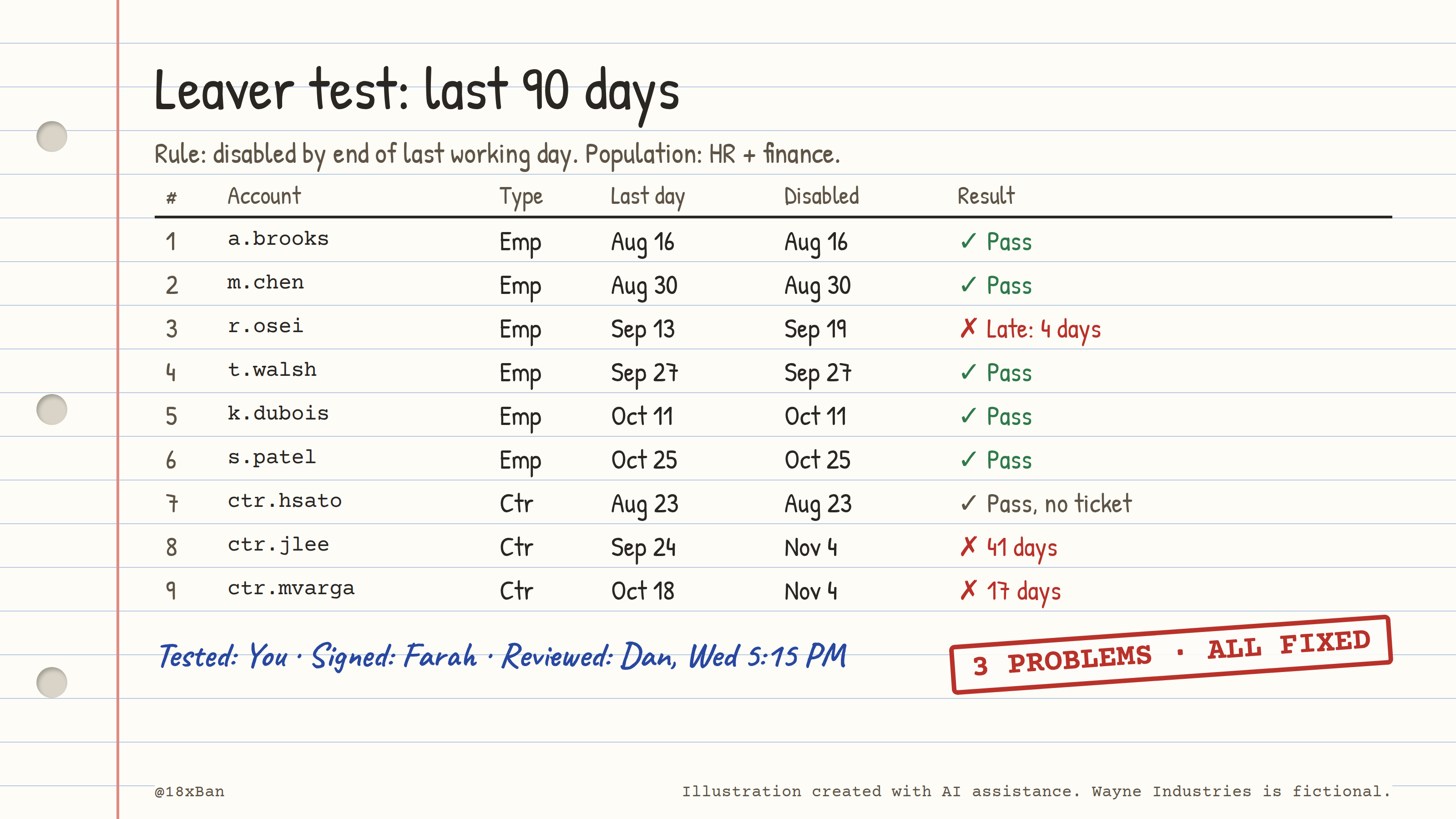
9 leavers, 1 late, 2 never done.
The unpopular truth: finding your own exceptions before an audit is the best result you can get. Exceptions you find and fix are a working control. Exceptions an auditor finds are a finding, and a question about everything else you told them.
Evidence #7
On Wednesday you put it together. It goes in Evidence/Access/Offboarding/:
The chain map for offboarding: the ERL row plus Wayne's 6 chain columns.
Dan's approval of the "end of last working day" rule, from Monday.
The HR export and the accounts payable list, with the reconciliation note.
The nine-row test sheet with all three problems written up: cause, fix and date fixed.
Farah's sign-off on the test, and Dan's review on Wednesday at 5:15 PM.
Evidence #7: a complete, reconciled offboarding test with its exceptions disclosed and fixed.
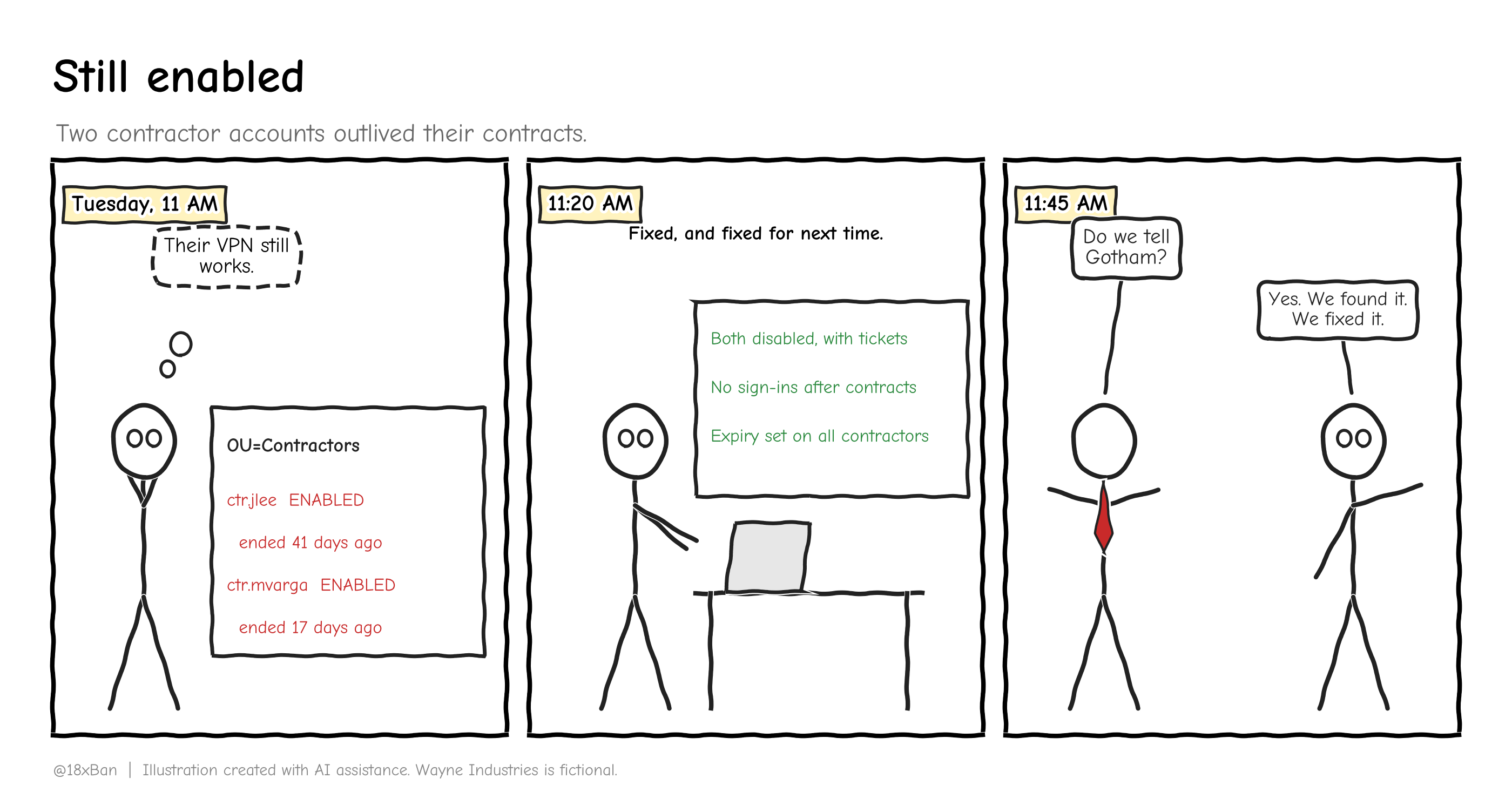
"Do we tell Gotham?" "We tell Gotham."
Thursday, 2 PM: the walkthrough
Gotham Mutual's analyst asks for the leaver list first. You show both sources and the reconciliation.
She picks row 8 and asks why a contractor kept access for 41 days. You show the cause, the fix, the VPN check and the new expiry dates.
She asks how she'll know it keeps working. You show the monthly test, who signs it, and where the next one will be filed.
She writes down 2 things: a finding that was self-identified and fixed, and a request to see next quarter's test.
That's not a pass. But it's a conversation that can end in a signed contract, which "trust us" never is.
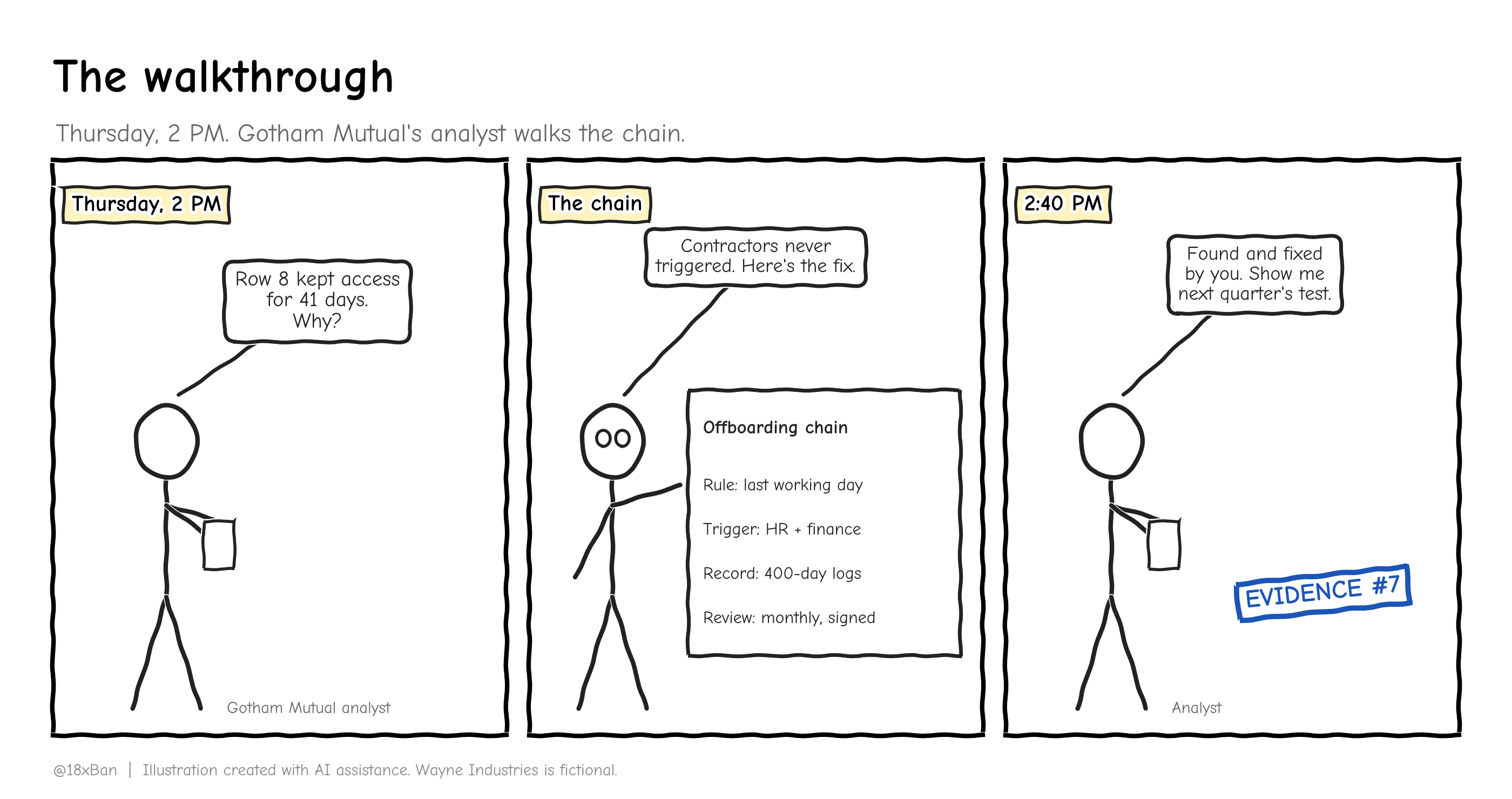
"You found these yourselves?" "Then fixed them. Here's the chain."
What an auditor accepts vs rejects
| Accepted | Rejected |
|---|---|
| A population drawn from every source, with a reconciliation | One system's list, with no proof it's complete |
| A system-generated record with a timestamp | A screenshot with no date, system or user visible |
| A ticket raised before or at the time of the action | A ticket created the week of the audit |
| Log retention that covers the whole audit period | "The log rolled over, but we definitely did it" |
| A review with a named reviewer and a date | A review nobody can show |
| Exceptions written up, with cause and fix | A test with zero exceptions and no detail |
| Evidence stored in one place with a retention period | Evidence gathered from inboxes on request |
What you actually do on Monday
Pick one control that an auditor or customer is sure to ask about. Offboarding is a good first choice.
Write the six links for it on one page: rule, trigger, action, record, review, kept.
Find every trigger source. HR, finance, vendor contracts, the agency that hires your temps.
Check how long your records really last. Look at log size and mode, not the policy.
Run the test yourself. Last 90 days, every leaver, last day vs disabled date.
Write up what you find, including the ugly rows, and get the owner to sign it.
Framework mapping
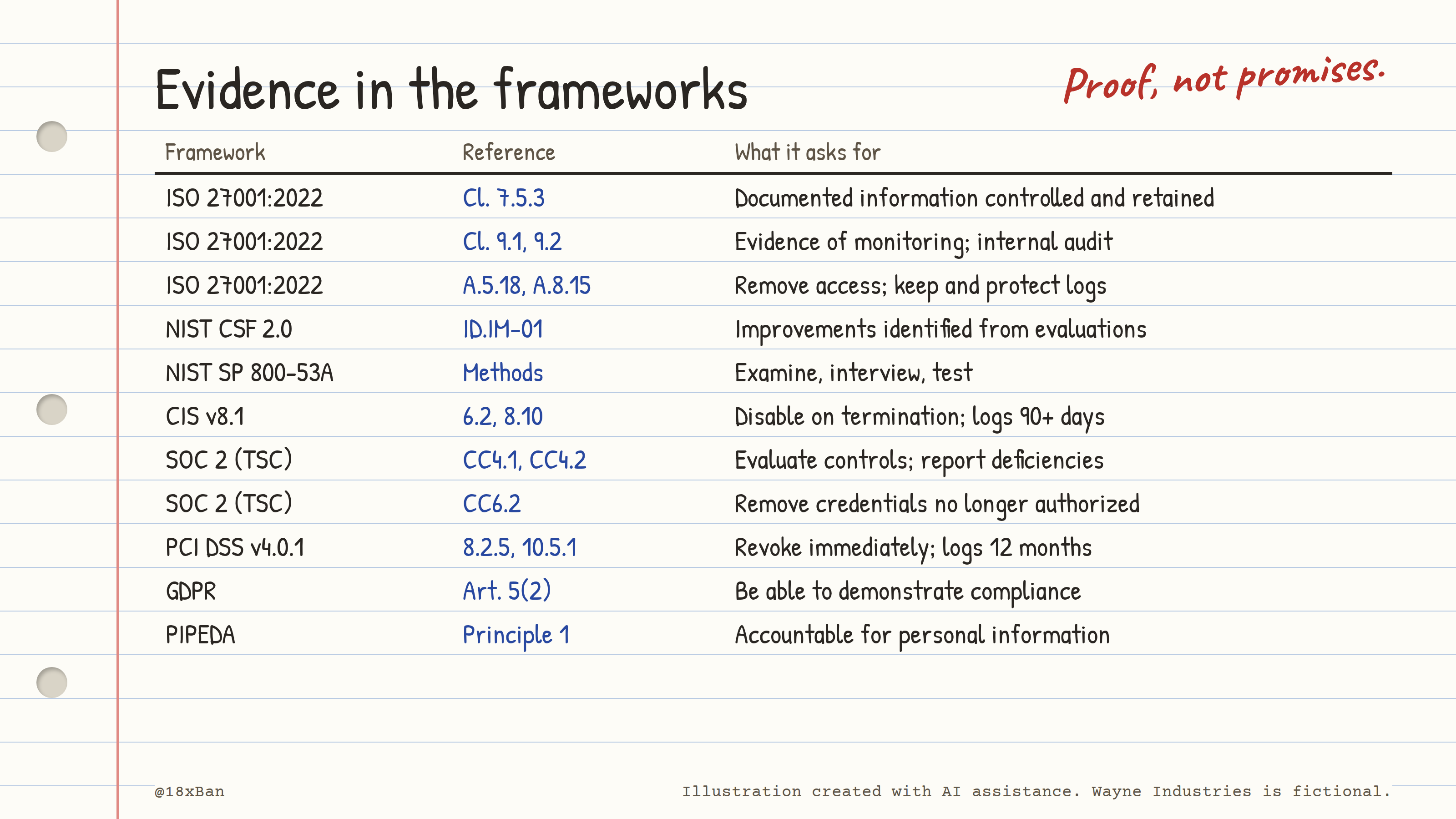
Every framework wants the same thing: proof, not promises.
Maturity ladder
| Stage | 20 people | 200 people | 2,000 people |
|---|---|---|---|
| Rule | One line in a shared doc, approved by the founder | Measurable standard in the access policy | Standard with defined SLAs per account type |
| Population | One spreadsheet of everyone, including contractors | HR and finance lists reconciled monthly | HR system feeds the identity platform automatically |
| Record | Admin console audit log, exported monthly | Directory events forwarded to central logging | SIEM with long-term retention and integrity checks |
| Review | Founder checks the list once a quarter | Monthly test by security, signed by the owner | Continuous monitoring plus internal audit sampling |
| Kept | One folder, one retention rule | Evidence folders per control, in the ERL format | A GRC platform linking every control to its evidence |
Be honest: at 20 people, the whole chain map is often one spreadsheet tab. That's fine, as long as every link has an answer.
Where Wayne sits: at the 200-person stage for one control, offboarding, as of Wednesday. Every other control on the list still needs its own chain map, and most of them have a link nobody has checked.
Cheatsheet
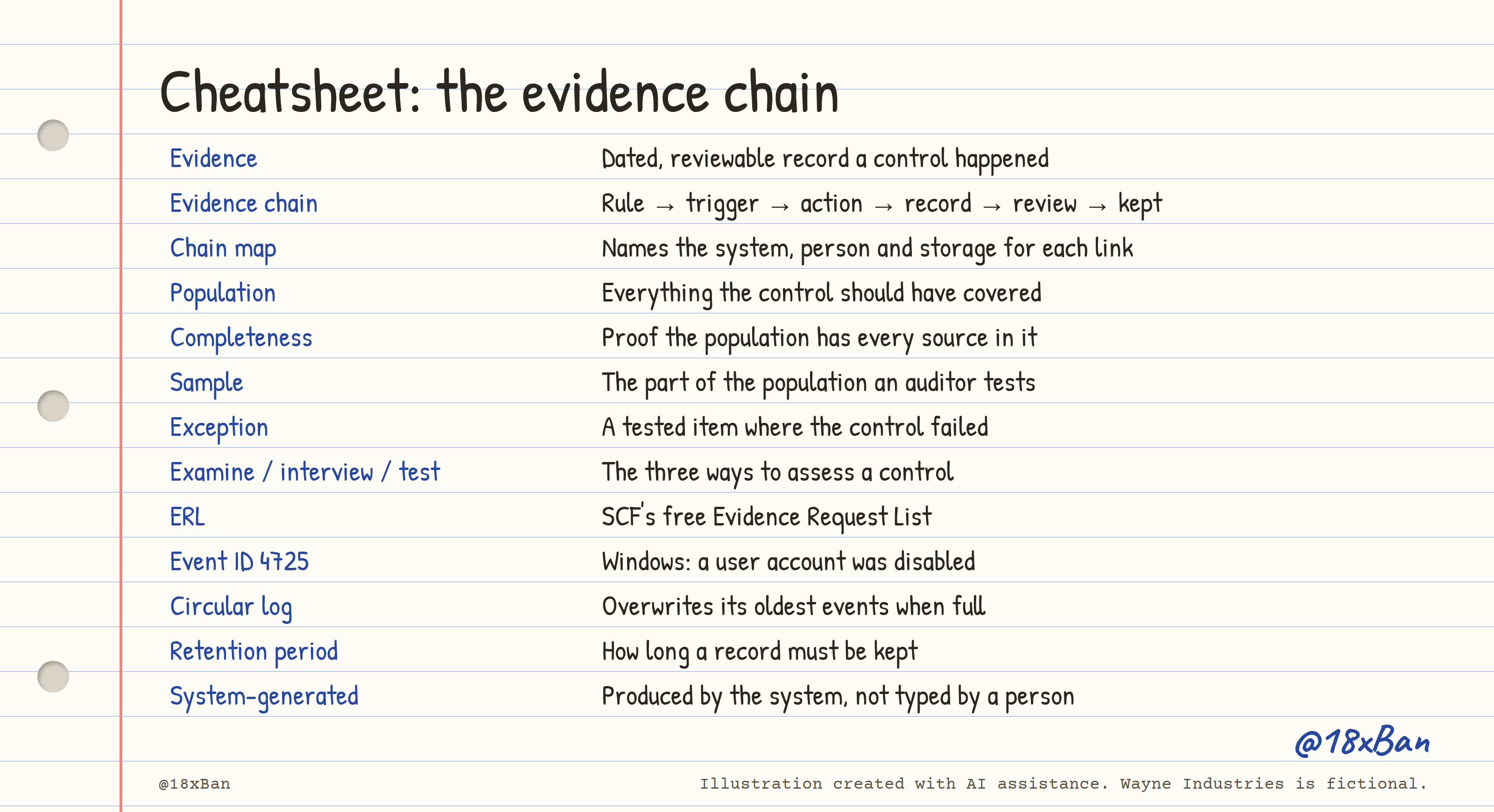
The evidence chain, on one page.
The takeaway
A control is only as strong as the weakest link between the rule and the stored proof. Prove the population is complete before you test anything in it. Check how long your records really last, not how long you think they do. Find your own exceptions first, write them down, and fix them.
⚠️ This content is for educational purposes only. Wayne Industries is a fictional company. Nothing here is legal, audit, or compliance advice, validate against your own auditor and jurisdiction.